
How Will AI Change Event Management in 2026? A Complete Guide for India
In 2026, AI is changing event management in India through smart automation across the entire event lifecycle — AI-driven venue and budget forecasting, facial-recognition check-ins, AI chatbots for attendee support, predictive analytics for attendance and engagement, AI-powered networking and lead-matching, generative AI for content and design, and humanoid AI robots for guest engagement. Agentic AI tools now handle agendas, reporting, and lead scoring automatically, while human planners focus on creativity, vendor relationships, and on-ground execution — making events faster to plan, more personalized, and easier to measure for ROI.
India’s event and exhibition industry is entering 2026 valued at roughly $6.15 billion, with analysts projecting it will cross $9 billion by 2031, while the country’s broader MICE and convention segment is expanding at nearly 13–15% a year — well ahead of the global average. That growth is colliding with a technology shift. Artificial intelligence has moved from a marketing buzzword into a working layer inside almost every stage of event planning, from the first budget spreadsheet to the post-event report a client reads the next morning. For corporate planners, brand managers, and MICE event organisers across Delhi NCR, Chandigarh, Mumbai, Hyderabad, and Bengaluru, the real question for 2026 isn’t whether to use AI — it’s where to start, and how to do it without losing the human craft that makes an event genuinely memorable.
95%
Event organisers worldwide expect AI use to increase in 2026
₹35K–40K Cr
Projected size of India’s MICE industry in 2026
200+ hrs
Average yearly time saved by businesses using event technology
60%+
Large Indian conferences expected to run hybrid formats by 2026
Why 2026 Is a Turning Point for AI in India’s Event Industry
Three forces are converging this year. First, India’s convention infrastructure has matured rapidly, with venues like Bharat Mandapam, Yashobhoomi, and Jio World Convention Centre giving organizers the scale and connectivity to run technology-heavy programmes. Second, demand is shifting beyond the metros — Tier-II cities are now hosting a growing share of MICE and corporate events, supported by government programmers such as “Meet in India.” Third, and most importantly, budgets are growing more cautiously than before: roughly 40% of organizers expect budget growth in 2026 and another 40% expect flat spending, compared to more aggressive growth the previous year. That combination — bigger ambitions, tighter discipline — is exactly where AI earns its place. It lets a leaner team plan more accurately, personalize more deeply, and prove ROI more convincingly, without inflating headcount or budget.
8 Ways AI Is Changing Event Management in 2026
1. AI-Powered Venue & Budget Forecasting
Instead of relying on last year’s spreadsheet and a flat 10% contingency “just in case,” AI tools now cross-reference historical event data with current market rates for venues, catering, and AV to predict realistic costs before a single contract is signed. For Indian planners juggling multi-city programmes — a leadership offsite in Jaipur followed by a product launch in Delhi, for instance — this means fewer budget surprises, sharper vendor negotiation, and contingency planning built on data rather than guesswork.
2. Smart Registration & Facial-Recognition Check-ins
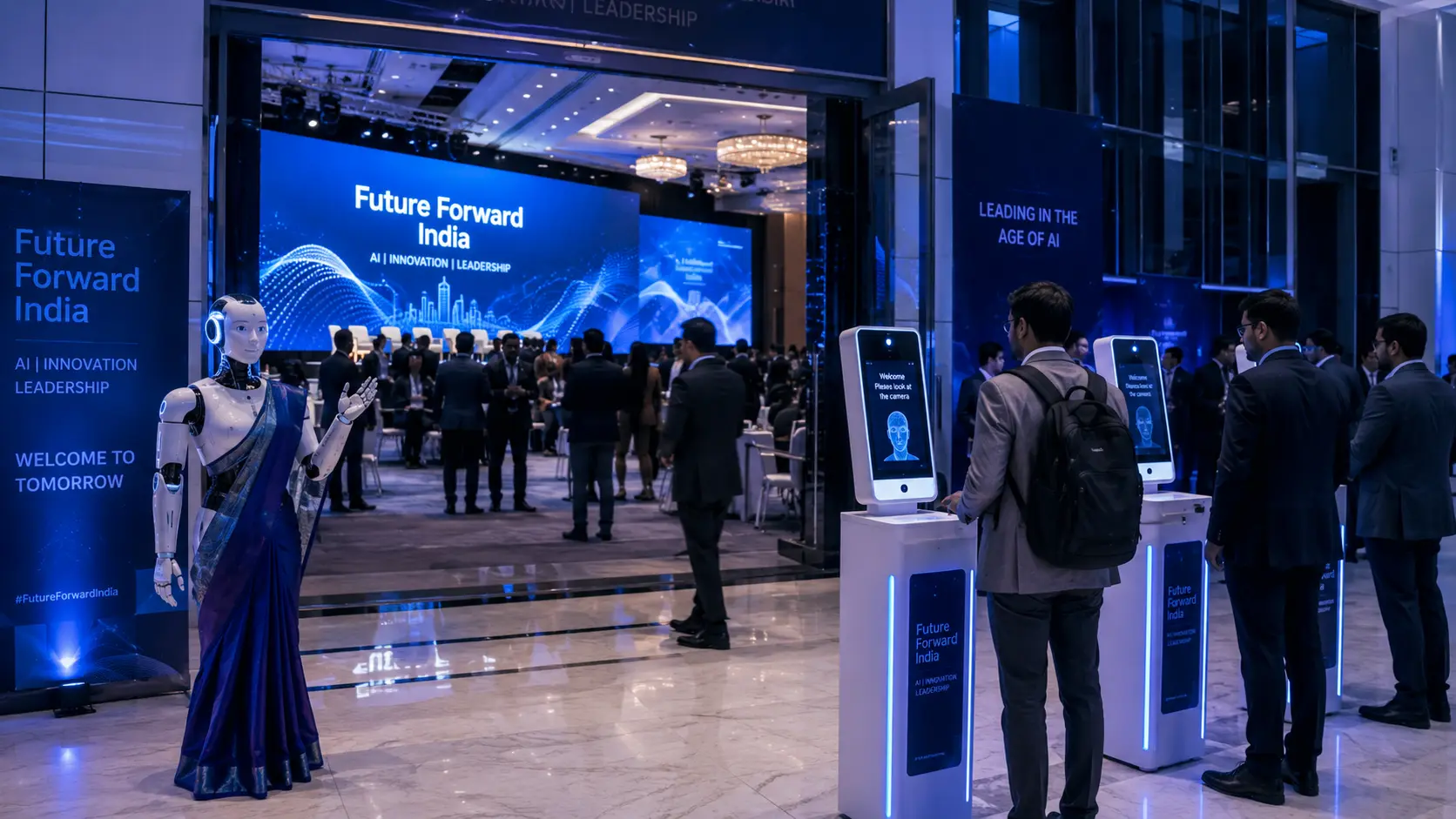
Long check-in queues at large conferences and exhibitions are quickly becoming a thing of the past. Facial-recognition kiosks and QR-linked smart badges can verify and check in a delegate in seconds, automatically print credentials, and sync attendance data straight into the organiser’s dashboard. At a 1,000-delegate MICE event management conference, that’s the difference between a chaotic first hour and a smooth, professional first impression.
3. AI Chatbots & Virtual Assistants
Multilingual AI chatbots — built to respond in Hindi, English, and regional languages — now handle attendee queries around the clock: session timings, venue directions, dietary requirements, and last-minute schedule changes. For exhibitions and trade fairs with thousands of visitors, this removes pressure from the human help desk and keeps response times near-instant, even during peak hours.
4. AI Robots & Digital Hosts for Guest Engagement
Humanoid AI robots, gesture-controlled installations, and AI-powered digital mascots are turning mall activations, product launches, and trade booths into genuinely shareable experiences. They greet visitors, answer basic questions, pose for photos, and collect engagement data — giving brands a “wow” moment that’s also generating measurable footfall and dwell-time data for the campaign report.
5. Predictive Analytics for Attendance & Engagement
AI models can now forecast no-show rates, predict which sessions will be over-subscribed, and flag scheduling conflicts before the agenda is finalised. During the event itself, engagement scoring through app activity and session check-ins gives organisers a live read on what’s working — invaluable when leadership is asking for real-time proof that the event budget is delivering results.
6. AI-Powered Networking & Lead Scoring
For B2B conferences and exhibitions, AI matchmaking tools connect attendees and sponsors based on role, industry, and stated interests, rather than leaving networking to chance. Agentic AI takes this further by scoring leads on the spot and routing qualified contacts directly into a sponsor’s CRM — turning a sponsorship stall from a brochure table into a genuine pipeline-building exercise.
7. Generative AI for Content, Design & Personalization
From drafting invitations and social captions to generating personalised session recommendations and dynamic on-site signage, generative AI is compressing weeks of content production into days. This matters especially for India’s younger, Gen Z-heavy workforce, who increasingly expect an event to feel like it was built specifically for them rather than for “everyone.”
8. Sustainability & Data-Driven Decision-Making
AI-based monitoring is helping organizers cut food and material waste by matching F&B and printed-material quantities to actual, rather than estimated, attendance. With nearly half of large Indian venues now adopting green operating practices, and multinational clients increasingly mandating ESG-compliant events, AI-supported sustainability reporting is becoming a standard line item in the post-event report, not an afterthought.
Planning a Tech-Forward Event in 2026?
From AI robots to smart check-ins, Raindrop Events designs experiences that blend creativity with the latest event technology — pan-India, end to end.
Real-World Examples: What AI-Enabled Execution Looks Like
Here’s how these capabilities typically come together across common Indian event formats:
Mall activation & brand experience: for a weekend mall activation, an AI-powered photo booth with facial-recognition opt-in and an interactive robot host can turn casual footfall into a queue of willing participants — while quietly logging dwell time, visitor demographics, and social shares for the brand’s campaign report.
Corporate conference / MICE event: at a two-day, 500-delegate industry conference, AI check-in can bring average entry time down from several minutes to under a minute per delegate, while an AI networking app matches attendees to relevant sessions and potential business contacts — turning a static agenda into a personalized itinerary for each guest.
Product launch: generative AI can produce personalized invitation copy and social assets at scale, while an AI-assisted hologram or projection-mapped reveal gives the unveiling moment the kind of visual impact that gets shared long after the event ends.
Traditional vs AI-Powered Event Management in 2026
| Function | Traditional Approach | AI-Powered Approach (2026) |
|---|---|---|
| Budget Planning | Manual spreadsheets, fixed contingency | Predictive forecasting from historical + market data |
| Registration | Paper forms or basic QR check-in | Facial-recognition check-in, instant badge printing |
| Attendee Support | Human help-desk, limited hours | 24/7 multilingual AI chatbot |
| Networking | Self-organised, name-tag browsing | AI matchmaking by role & interest |
| Content Creation | Manual drafting, days of turnaround | Generative AI drafts in minutes |
| Post-Event Reporting | Manual data compilation, days later | Auto-generated dashboards, near real-time |
⚠ Where AI Still Needs a Human Hand
AI is a powerful assistant, not a replacement for experienced judgement. Facial-recognition and biometric check-ins must be deployed with explicit attendee consent and handled in line with India’s Digital Personal Data Protection (DPDP) Act, 2023. AI-generated content still needs human review for cultural nuance and brand tone, and no chatbot can read a room, manage a difficult VIP guest, or improvise when a vendor cancels two hours before doors open. The events that succeed with AI in 2026 are the ones that use it to remove repetitive work — not to replace the planner who’s actually in the room.
How Raindrop Events Brings AI Into Your Next Event
With over a decade of experience delivering event management, BTL activations, and brand experiences across India, Raindrop Events has built a dedicated AI Event Solutions practice — combining AI robots, facial-recognition check-ins, interactive displays, and holographic content with the creative and production expertise our clients already trust us for. Whether you’re planning a single-city product launch or a multi-city corporate event management programme, our experiential marketing and AI specialists design the technology layer around your event goals, not the other way around.
Frequently Asked Questions
How is AI used in event management in India in 2026?
In 2026, Indian event companies use AI for budget and venue forecasting, facial-recognition check-ins, 24/7 multilingual chatbots, AI-powered networking and lead scoring, generative AI content, and humanoid AI robots for guest engagement at malls, conferences, and product launches.
Will AI replace human event planners in India?
No. AI automates repetitive tasks like check-in, reporting, and basic content drafting, but vendor relationships, creative direction, crisis handling, and on-ground execution still require experienced human planners — which is why most agencies use AI as a co-pilot, not a replacement.
How much does it cost to add AI features to a corporate event in India?
Costs vary widely based on scale — a single AI robot host or facial-recognition check-in kiosk for a one-day event costs far less than a custom hologram or a multi-day AI networking platform. Most event companies, including Raindrop Events, scope AI features against your budget and goals during a free consultation.
Is AI facial-recognition check-in safe and legally compliant in India?
Yes, when implemented correctly. Organizers must obtain clear attendee consent before collecting facial or biometric data and handle it in line with India’s Digital Personal Data Protection (DPDP) Act, 2023, including secure storage and timely deletion after the event.
Which types of events benefit most from AI in 2026?
Large-scale MICE conferences, exhibitions, mall activations, and product launches see the biggest gains, since they involve high attendee volumes, repetitive check-in and support tasks, and a clear need for measurable engagement data that AI tools are well suited to capture.
Ready to Make Your Next Event AI-Powered & Unforgettable?
Talk to Raindrop Events’ planning team about bringing smart technology, creative design, and flawless execution to your next corporate event, conference, or activation — anywhere in India.